 While working a 9-to-5 in publishing, Lauren Culley spent nights and weekends sweeping floors for free at bakeries around Brooklyn just to learn the craft. She eventually left publishing for good and took a full-time bakery job at Blue Bottle before it went global. She met her husband, Jeff Excell, the cafe’s manager, on her first day. A visit back home convinced her the Columbus food scene was ready for something new, so the couple packed up and moved to bring a Midwest-inspired concept to the city. Worried at first that the first Fox in the Snow location wouldn’t draw enough foot traffic, she’s since grown it into seven locations and one of Columbus’s most beloved bakeries and hangout spots.
In our conversation, Lauren unpacks the decisions, setbacks, and turning points behind Fox in the Snow’s growth, from a Craigslist “garage for rent” ad to seven locations across Columbus.
You were living in New York, working in book publishing. Take us back to how you got started.
I was living in New York, working in book publishing, and I just wanted something I loved to do on nights and weekends. So I volunteered for different bakeries around Brooklyn. I’d work their cash register, sweep their floor, do whatever they needed, just so I could be in that environment, be in a kitchen, and learn through osmosis about an industry that was really new to me. I had no experience with it. I was just looking for experience wherever I could get it.
Eventually, I got to the point where I looked forward to the hobby more than the job. So I decided to make the leap, quit my job in publishing, and work in a bakery full-time. On my first day, I walked in, introduced myself to the barista behind the counter, and told him it was my first day. It turned out to be my now-husband (Jeff Excell), who was the manager of a cafe called Blue Bottle. The brand has gone global; they’re in grocery stores now, they’re everywhere. But when we were working there, the husband and wife who founded it were still very much a part of the business, and we were both employed at their first East Coast location. They started in San Francisco; Brooklyn was their first location outside California. He managed the front of house; I got hired to work in the kitchen and eventually became the back-of-house manager. So that was our first experience of him working the front and me working the back, working together, learning how a cafe ran and what we liked and what we didn’t like. We became friends, then we started dating, and it all happened very quickly.
So how did that turn into moving to Columbus?
I came back to Columbus to visit family, and I was talking to them about the cafe I worked at in Brooklyn and the food scene there. I went to undergrad at Ohio State, but Columbus felt very different than it did when I was in school. The food scene was much bigger; it felt a lot younger, and different areas were changing in ways that weren’t even there when I was in school. I mentioned to my dad, “If somebody came back and did a cafe here, I think they’d really crush it.” And my dad said, “Why don’t you just do it?”
I went back to Brooklyn and met Jeff at a bar and said, “I think I’m going to go back and try this. If I don’t do it now, I’m never going to do it.” He said, “I’ll do it with you.” He’d never even been to Ohio. He was like, “Let’s take the jump, let’s make the leap.” So we came back, got a lay of the land, and spent the next year coming up with the whole concept for Fox in the Snow: menu, logo, name, aesthetic, all of it. We came back in January of 2014, and by October 2014 our first location was open.
Did you love baking growing up? What drew you to it?
If you talk to my parents, they’ll say I did not bake when I was younger. I wasn’t interested in cooking. I was never the kid on the stool in the kitchen. But I’ve always been interested in the arts. I got my master’s in fine art after undergrad. I’ve always been drawn to anything creative where you’re making something.
I think what happened is that when I was in Brooklyn, there was a thing called the Brooklyn Flea, tiny food startups that all get together, and you could try artisan olive oils and scones and all kinds of things. I went with my mom, and there was a bread baker there who’d made the mozzarella that morning; it was still warm, and he’d rip the bread apart by hand.
Everything felt so real in a way I didn’t have much experience with. It made my brain explode, like, here’s this whole other area of creativity I hadn’t tapped into, this whole other way of making something. It was so attractive to me. I think having another creative outlet is what drew me to food in the first place.
But also, I was working in an office, and I wasn’t getting any tactile satisfaction. I wanted to be working with my hands; I wanted that instant gratification of making something and having it there right away. I think I was lacking that behind a desk. So it was this perfect storm: another way to show creativity, something tactile, being around my peers, and a new area of expression opening up. And the timing of it just was perfect.
Do you consider yourself a baker now? Do you still bake at home?
More so when Fox in the Snow first opened, because I was the primary baker for so long, opening the shop every day and closing it every day. My job has really evolved to the point where I’m not baking every day anymore. So I’d say it’s gone through ebbs and flows. I baked for pleasure, then turned it into a job, then baked for my job, and now I’m back to baking for pleasure.
The menu part of my brain is always engaged. What’s the next thing we’re going to add? What should it taste like, what should it look like, how are we going to display it? That’s always engaging, but the production side, less so.
I do like baking at home, but I also think, and I don’t know if people who work in commercial kitchens feel this too, you get so used to baking in large batches with an industrial oven, everything at your disposal, that baking at home feels a lot harder. When you’re used to measuring in pounds, and then you have to measure a quarter cup, there’s a click that doesn’t always happen in my brain.
I think part of being an entrepreneur is that your job changes every year. The job I had twelve years ago is very different than the job I have now, and even the job I had two years ago is different than now. Being nimble, learning something new, or recognizing you need somebody who’s an expert to do it for you- I think that’s a large part of it. The business got to the point where having bakers who were more experienced than me, or who could give more of themselves to it than I was able to, was a large part of the journey too.
Talk about the original vision. You thought it would be a coffee shop with a bakery, but it turned into a bakery with some coffee.
I grew up with my mom and my aunts and my grandma making what I consider Midwest heartland baked goods: big, bready cinnamon rolls, nothing tiny or delicate, everything made by hand, hand-folded pie dough, ingredients that are in season. I felt like there was a hole in the market for that.
I’d worked in a number of French bakeries, a number of cake bakeries, but I hadn’t worked somewhere making the kind of pastries I grew up with, things that lacked pretense, just banana bread, just coffee cake, things I grew up eating that were really familiar, but the best version of that thing. That’s still our north star: is it accessible, does it bring up feelings of nostalgia, is it made by hand.
We also had a really small team, just me and one other baker when we opened, so we had to think about what we could make in large batches instead of making to order. That’s where the soufflé egg sandwich came from, because a soufflé has 24 portion sizes instead of frying an egg one at a time. A lot of it came out of necessity, and a lot came out of nostalgia, and I think we still operate like that.
The coffee menu was influenced by the places we’d worked at in New York. We didn’t have a lot of flavors at the time; we had one size of coffee; we were doing a lot of pour-over, and we really tried to pay attention to the quality of the coffee and the aesthetic of everything: a beautiful rosetta in your latte, somebody hand-making your pastry, and then the third part, the aesthetic of the space you’re eating it in.
How did you land on the original Fourth Street space?
We thought the cafe would be really tiny. We were looking for something around 800 square feet, maybe a thousand. We kept finding a location, and then a developer would buy it and tear it down.
We were on a real estate hamster wheel. One day I went on Craigslist and found a post that said “garage for rent,” no photo, just a map, and I saw it was on Fourth Street. I called the landlord and said I wanted to turn it into a bakery.

The original Fox in the Snow building on Fourth Street before renovation
She said they were considering having somebody use it as storage for their eBay business. I said, “I’ll sign a 15-year lease. I want to turn this into a bakery; I’m going to make it beautiful.” She showed it to us the next day, and by the time we left, we put our name down on an LOI. When we signed it, she said, “My only ask is that you serve banana bread.” That’s truly why banana bread is on the menu now: because of Carol, our then-landlord.
The space was so much bigger than we imagined, and all the money we’d saved for beautiful tile or wallpaper- this probably overwrought design in our heads- went into an HVAC system, a plumbing system, a new electrical panel.
By the time it was time to design the cafe, we were out of money. That’s where the modernity of Fox in the Snow comes from: the minimal wood, cinder block, glass. We couldn’t cover the cinder block with anything fancy, so it stayed cinder block. We couldn’t afford to turn the cement floor into tile, so it stayed cement.
The way we made it feel more beautiful was to add trees and change the way it felt. A lot of the Fox in the Snow story is that it came out of necessity: we needed to be scrappy, so we did X, and now that’s part of the whole aesthetic, this minimal cement, stone, trees, glass, steel look. That’s still how it is today.
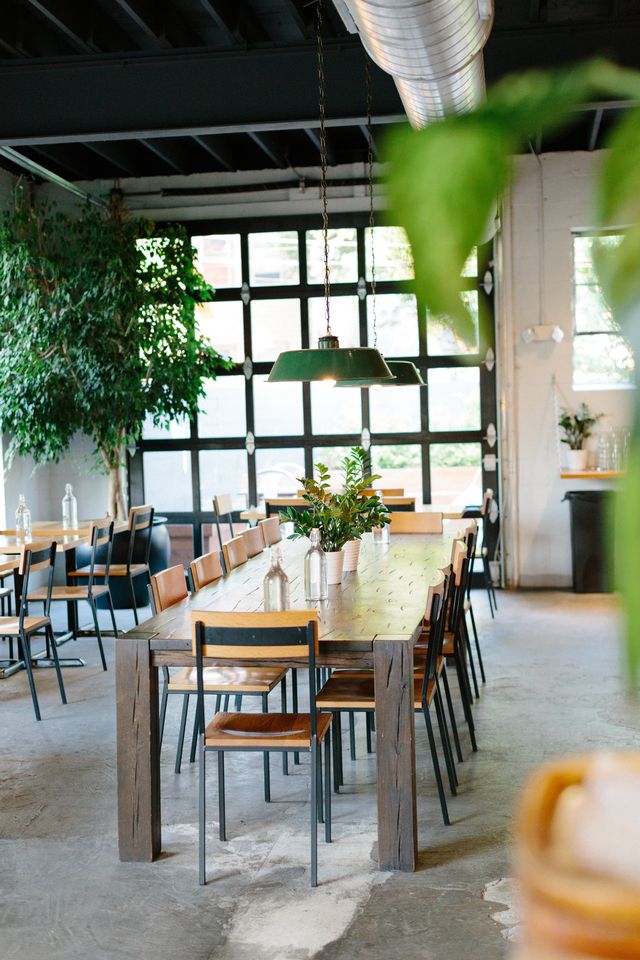
The look that came from a tight budget: cement, cinder block, glass, and trees.
Once you opened, were people coming in the door right away? Was it what you expected?
This answer has two parts. One, to be totally honest, the first couple of months are kind of a blur, because you’re up at 3 am and going to bed at 10 pm, seven days a week. It’s like having a newborn; you’re just on, and you don’t really remember how you got through it. But also, we were busy from the start, and I don’t know how, other than I think it’s the Columbus way: I found it, told 10 people, and those 10 people came in and told 10 more.
We thought we’d have a slow opening. We didn’t even have a dishwasher because we figured we wouldn’t be that busy; we thought the baristas and kitchen would just wash their own dishes at the end of the day. We had no one making egg sandwiches because we figured, how many? 12 a day?
That first weekend we were open, we were so busy my mom came in and washed dishes because I said, “We’re drowning; I don’t know how we’re going to get through this.”
We had my whole family on deck. People would come in and say, “My friend at work told me to come, so I brought my family,” or “I heard about this place from my coworker.” I really think Columbus willed it into being. When we opened it, it wasn’t what it is now; the food’s gotten better, the menu’s gotten bigger, the quality’s gone up, but I think it was just, if you know, you know. And not having a sign was actually helpful for us; it contributed to that feeling. It was busy from opening weekend, and it felt like we were playing catch-up for literal years after that.
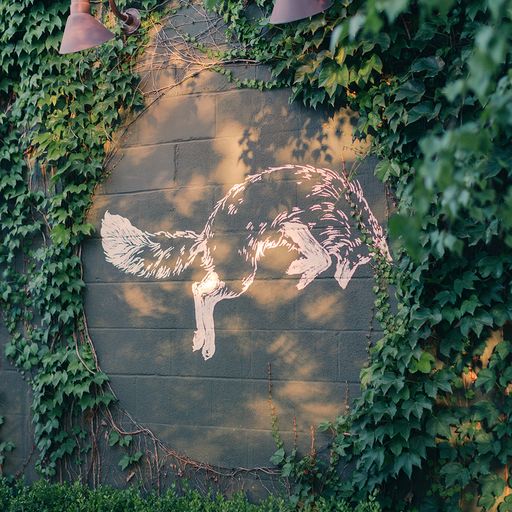
The Fox in the Snow logo on the wall. With no name on the building, it had an “if you know, you know” feel.
You’ve grown from one location to seven now. Walk me through that.
Coming from Blue Bottle, we saw them go from one location to six during our time there, so growing a coffee shop didn’t feel chaotic or out of control; it felt normal. I think we always imagined growing; we just didn’t know how, especially when you’re so in it. It’s hard to work on the business when you’re in the business.
When we first opened, we were still dating, not married, no kids; we were at the very beginning of everything. And like a lot of entrepreneurs, we were trying to grow the business and grow our personal lives at the same time. We opened the first location, got married the year after, got pregnant the year after that, and opened the second location the year after that. So it took almost three years to go from location one to location two, and you do that thing where you leverage yourself and take on new debt.
Then we got pregnant again while figuring out how to run two locations, and it was probably another two years before location three. Then about four years between location three and four. So we really took a long time between locations in the beginning.
But what’s also happening during that time is you’re building a foundation of resources and a team. In the beginning, the team was me, Jeff, Anna running our kitchens, and Jack running all our cafes, just four of us running through everything.
When you get more locations, you obviously need more people, and we had this foundation, plus a team of incredible baristas and bakers who were ready for more opportunity. You wait until you have people ready to go to different places and teams ready to grow, and then it doesn’t feel like as much of a push. It took us a long time to go from one location to four, and then from four to seven took about a year. You spend all that time building the plane so the plane can fly.
What’s your vision for the next five to ten years? More locations outside Columbus?
I definitely think that feeling of having people who want to grow with the company, having incredible team members, is still very real, and giving those team members the opportunity to grow within the company is something I feel really passionate about.
I do think we can accommodate more locations. As for where, even your best intentions of “we’re going to go here and here” run into the fact that real estate is so fickle. For our Clintonville location, we found and signed a lease within 30 days. Our Upper Arlington location took well over a year to sign. So you can have plans, but until the real estate shows up, you’re kind of in a hurry-up-and-wait situation.
If a perfect location opened up outside Columbus, we’re definitely ready and excited about that. But we also want to give Columbus a little breathing room. We just opened three locations in eight months, so I think we might wait, let those mature, and catch our breath. Real estate is so much about what comes up and when. You’re kind of at its mercy.
Are you the one making the real estate calls?
We have somebody on our team looking at locations, and Jeff, my husband, has a lot of interest in that.
I come in for a gut check: can we make it feel like a Fox in the Snow? There are realistic things you check off: parking spaces, traffic count, population, the numerical stuff. But the real gut check is, does this feel in my bones like a Fox in the Snow? That’s the fun part; that’s where I get to decide whether it’s somewhere we want to be.
What’s surprised you most about running the business?
I think you go into starting a business thinking your job’s going to be one thing, and then it becomes a million different things. I don’t know that I was prepared for that. I think, “I might be a baker, but I’m still going to have to do the taxes.” All these other things happen, especially as you grow, that you can never be fully prepared for. The flexibility you have works well with my personality and Jeff’s, but I was very naive about how much your job changes over the years.
One of the biggest surprises was how much the space belongs to the customer; it belongs to the community. That’s been a beautiful surprise, a very happy surprise, but to have the thing you’ve built become bigger than the people who built it has been overwhelming and humbling and wonderful.
Now we’re at the point where people have memories associated with Fox in the Snow. People say, “We always come here on Christmas Eve,” or “My mom always took me here on the first day of school.” Becoming part of people’s memories or their routine, I wouldn’t have expected that, and I think that’s amazing.
And we’ve been incredibly lucky to have really talented, hardworking, devoted people on our teams. When we opened, it was a team of four, and before that, a team of two.
Imagining your team going from two to 200 isn’t something your brain can process at first. To watch it now, to know the number of people who show up every day, get the door open, put the pastry in the oven, make the coffee, remember customers’ names as their orders become part of their routine, that’s also surprised me in the best way.
What’s been your favorite job through all of this, and your least favorite?
Being a creative person, my favorite job I’ve ever had is being a morning baker. You get there at 3 or 4 in the morning; it’s still dark, and when we were doing it, I was there by myself.
You go in, get to work, and something you put in the oven comes out beautiful, and you’re making it look perfect. It’s all the work of making the dough, making the icing, and then the product is the final product, and you get to do that.
While you’re doing it, the sun’s coming up, you feel really productive, you’re busy, and all of my senses are hit when I’m doing a morning bake. There’s something really singular and special about that.
It’s not for everybody. I don’t think trying to convince somebody that showing up at 4 am and working alone for four hours is incredible works on most people, but it was so special for me.
Anything outside of something I feel confident with is harder for me, because I feel like I can’t contribute as much as I want to. Having a good financial team, somebody working on the finances, the projections, the budgeting, has been a real game changer.
Jeff and I could do it, especially Jeff, but never to the point where we felt confident it was getting done the best it could be. Having somebody come in who understands it has been incredible.
Getting to the point where we have the right people in the right seats has taken a really long time, over a decade, truly. But once you’re there, there’s an ability to breathe that maybe wasn’t there before.
What does Columbus mean to you and to this business?
I wanted to create a place that represents the heartland, that celebrates the Midwest, celebrates its flavors.
I think I underestimated Columbus’s loyalty to places that started here. There’s an enthusiasm for new places I don’t think exists elsewhere, and it’s not just something that’s cool for six months and then forgotten; Columbus really shows up and keeps showing up. To be 12 years in and still have opening-day-style lines, I don’t know another city where that could have happened.
My husband always says he’s never been in another city where people are more proud to be from it. I think Columbus really shows up for places that show up for them. What we built absolutely couldn’t have happened in another city. I’m convinced of that.
What’s it like working with your husband, and how has that evolved?
I’ve never not worked with Jeff, since I met him on my first day, so I only have experience working together and being in a relationship together.
The way we’ve figured out how to make it work is we really have our own lanes, and we try not to cross into the other person’s. We really respect what each other brings to the business, and they’re very different things.
Jeff does real estate, numbers, payroll, insurance, taxes, and front of house; he understands how a barista moves through a space and what the day should look like up front. I’ve never veered into that; it’s not my area of expertise. I’ve stuck to the back of house, the menu, the brand, how the shops look. He’s almost never questioned my ownership of that, and we’ve given each other space to do what we want in our own areas.
I can’t imagine not working with your partner. Whenever we say we work together, more than 90% of the time somebody says, “Oh, I could never.” But it’s all I know.
I think it’s also about having the right people in the right seats, because we have team members now who think my part of the job sounds terrible, and they’d rather just analyze data. That’s not my area, and I think we push each other in the right ways too.
We can make something and most of the team will taste it and say, “This is incredible.” I’ll taste it and say, “It’s good, but it could be better.” Not having somebody over your shoulder saying, “It’s good enough,” letting me push it as much as I want, and letting Jeff do things the way he wants, gives each of us the space to realize something.
How does being a mom fit into all of this?
That’s another thing that’s evolved. I’ve never been a mom without being an entrepreneur, so this is the only way I know how to do it. There are some real perks; I kind of got to make my own schedule when I had my babies, and that was amazing. At the same time, you’re never fully not working, whenever there’s a problem, you’re still looped in on it.
When I had my second child, my daughter, I was in labor and delivery while we were getting the health inspection for the New Albany location. I was texting with the team, trying to figure out whether we’d passed.
I had her on a Thursday and opened the doors to New Albany on a Saturday. I strapped her to my chest and went to go open the shop.
There’s not really an option; the shop still has to open, so you strap the baby to your chest and go. You figure out a way to make them both work.
There are real pros and real cons to it. My kids are a little older now, and the past couple of years have been the first time I’ve seen them really proud of it, feeling some sense of ownership, like this belongs to our family. That’s been really cool; I couldn’t have imagined what that would look like.
Being a working mom is hard in any capacity, but I feel really lucky to have done it the way I’ve done it.

Lauren Culley and her husband Jeff have built a business their family is proud of.
At the beginning, you mentioned your dad telling you to just start the business. Do you think he expected it to become what it is now?
I appreciate you asking me this; no one has ever asked me this question, and I love the answer so much, it could almost make me cry. When we had this idea, we were like, we’re going to do this coffee shop; it’s going to be this and this.
Most people we talked to tried to talk us out of it, thought we were crazy. When we were opening Four Street, we said, “The line’s going to go here,” and the person in the room basically laughed. We had this inflated idea of what we’d be.
From the beginning, my dad said, “This is going to work. Don’t change the name. This is where the line’s going to go.” He just believed in it. I think he believed in it more than me and Jeff did, especially once we were open.
We worked from 3 am to 9 pm, and I was so exhausted I genuinely didn’t know how we were going to do it; I saw no end in sight. It was great because there was a line, but I was like, how am I going to keep up?
My dad would come drop off lunch and say, “It’s going to work, I know it’s going to work, you got it.” He’s still involved; he still comes to board meetings and weighs in on things, and he was definitely our first champion, always our number one fan. I don’t know that anybody’s ever asked me about it, but yeah, it wouldn’t exist without him for sure.

Lauren Culley’s Dad, Fox in the Snow’s first champion
What excites you most about the business right now?
Knowing the team we have, having people working with you who are thinking about the future is so exciting, and honestly foreign, because for so long it was just the two of us imagining everything, pushing ourselves.
Having people around us who can take an idea and make it happen, or push it to be better, is exciting because it’s not just me imagining where it can go anymore. It’s a team of people asking “what if we did X,” and that grows bigger than what I can imagine alone. Having a team that can put things into practice faster than Jeff and I could have is also exciting.
I truly believe the food we’re putting out in year 12 is better than what we put out in year two, and that we’re making so much more of it while still making it better.
We’re still rolling out every cinnamon roll by hand, folding every galette, making our own jam, and slow-cooking our custards. That’s something I’m really proud of. Growing while still figuring out how to keep it genuine is exciting to me.
I think I’m excited to see what it becomes, because I couldn’t have imagined this 12 years ago.
I like to think it’s something I can’t even fully imagine right now; that’s the fun part. If I’d known then what I know now, there are two things: would I still do it? Because it’s really hard, but also it’s so wonderful. I don’t even want to know what’s coming in 10 years, because if I knew, it might scare me away, or maybe it’s better than I could imagine.

The tomato tart is a popular seasonal savory pastry featuring a flaky, buttery crust filled with a rich cheese and herb layer topped with fresh, ripe tomatoes
Where do you think Columbus can improve or grow from where it is now?
One of my favorite places to eat is Gene’s in Dublin.
When I went, it felt like a new avenue for restaurants: small, in a new spot, and designed in a new way. I think we get used to big spaces, big parking lots, places that feel like a carbon copy of somewhere else. Gene’s didn’t feel like a carbon copy of another thing; it felt like its own thing. I’d love to see more places like that, where I haven’t seen this in another city because this is the only one that exists.
I think Joyas is like that too; it doesn’t feel like a version of something I saw in San Francisco; it feels like its own thing.
I like to think Fox in the Snow is like that too. Design trends are going to come up across any city no matter where you are, but it’s the combination of that with a menu that isn’t in a hundred other places that’s really exciting. I’d like to see more places that don’t feel like a copy of another thing.
Comune feels like that too, not trying to be like a hundred other places. There’s something really authentic about that, and I think Columbus does reward it; they appreciate it.
But those places are scarier to start up. I think it’s probably that turning tables in a very small space is hard, though I don’t know the restaurant industry as much as I know the cafe industry, and the cafe industry is such a volume-based business. Honestly, being an entrepreneur kind of ruins you from going out and just enjoying places, because you’re always trying to figure out everybody’s business model, how many people are working, what their payroll looks like, what their rent is. You exist in your own bubble for so much of your life; you know yours like the back of your hand, so it’s natural to be curious about other people’s.