Three months into his first job as an allergist, Dr. Summit Shah came home on his lunch break and told his pregnant wife he’d quit that morning. He moved back to Columbus, opened Premier Allergy & Asthma in a 700-square-foot Dublin office that had been used to store an OB-GYN’s old paper charts, and has since grown it to 13 locations across central Ohio.
In our conversation, Dr. Shah talks about why he doesn’t believe in the self-made man, the licensing mess that taught him not to overextend himself, and the investment in people that has fueled Premier’s growth.

Did you always know you wanted to be a doctor?
When my parents first moved from India in the ’60s and ’70s, we had a lot of family members who were in healthcare. So I grew up with a lot of physicians in my life. I always looked up to them because they were so passionate about what they did that it was their life. They would eat, breathe, sleep medicine, and I really admired that.
At one point, when I was in high school and college, I wanted to do a gut check and make sure I wasn’t doing it for the wrong reasons. I really love math. I actually considered being a math teacher at one point too. But the more I shadowed other physicians and spent time exploring other careers, the more I was drawn to the field. I love science. I love the human body and how dynamic it is. I do think I knew at an early age that I wanted to be a doctor.
What drew you to allergy and immunology?
You do four years of undergrad, four years of medical school, then residency, and then you can do a fellowship after residency. My problem was that I loved every rotation I did in medical school and residency. People would ask me in med school what residency I was going to pick, and I loved OB-GYN, internal medicine, and pediatrics. I even enjoyed some of my psychiatry rotations, which I never thought I would. So I went into internal medicine first because that left the most doors open.
Then the same thing happened to me in internal medicine. I really enjoyed being in the hospital, caring for sick patients, and working with patients in the ICU. Medicine is so complex, and you have to learn about all the different body systems and how a drug can help one part of the body and hurt another. I loved all of that.
Ultimately, I chose allergy for two reasons. One is that allergy is mostly done in the clinic, in the outpatient setting, not in the hospital. I loved being able to form a relationship with the patient. “Hey, Mrs. Smith, how are the kids doing? How was your last vacation?” Once you build that trust with the patient, the medical advice piece, and them listening to the treatment you want for them, becomes easy. When patients are really sick in the hospital, it’s hard to establish that relationship.
The other reason is that allergy is one of the few fields where you can actually reverse the disease process. If you have high cholesterol or high blood pressure and you’re given a medicine, oftentimes you’re taking that medicine for the rest of your life. With allergy shots and allergy immunotherapy, we can actually make people unallergic to the things they’re allergic to. I thought that was super interesting and super cool. Those two reasons are the gravity that brought me to allergy and immunology.
In a LinkedIn post, you credited your family for where you are today. What role have they played?
If I had to pick my biggest pet peeve, it’s the person who says they’re a self-made man, because I don’t think there’s such a thing. Especially in my case, going back multiple generations. When my grandparents decided to send their kids to the United States, this was before cell phones. They couldn’t even talk to their kids. They would write letters back and forth. My uncles came over on a steamer, and my grandparents didn’t see their own kids for years and years. But they sent them to the United States because they knew it offered a better future, with a stronger education system and more business opportunities.
My parents did the same thing for me. I grew up on the west side of Columbus. My dad owned a small motel with 27 units, and we lived there. But they made sure we had the best education. They sent me to Saint Mary Magdalene School and Watterson. They worked really hard, and when it came to education, they wanted to make sure I was getting the cream of the crop.
Because of their sacrifices, Premier Allergy & Asthma is here. I look at it as kind of turnkey. I just had to jump in and do the work: pass the exams, take the tests, get through residency and allergy fellowship. The foundation was already there. I just had to plug myself into it.
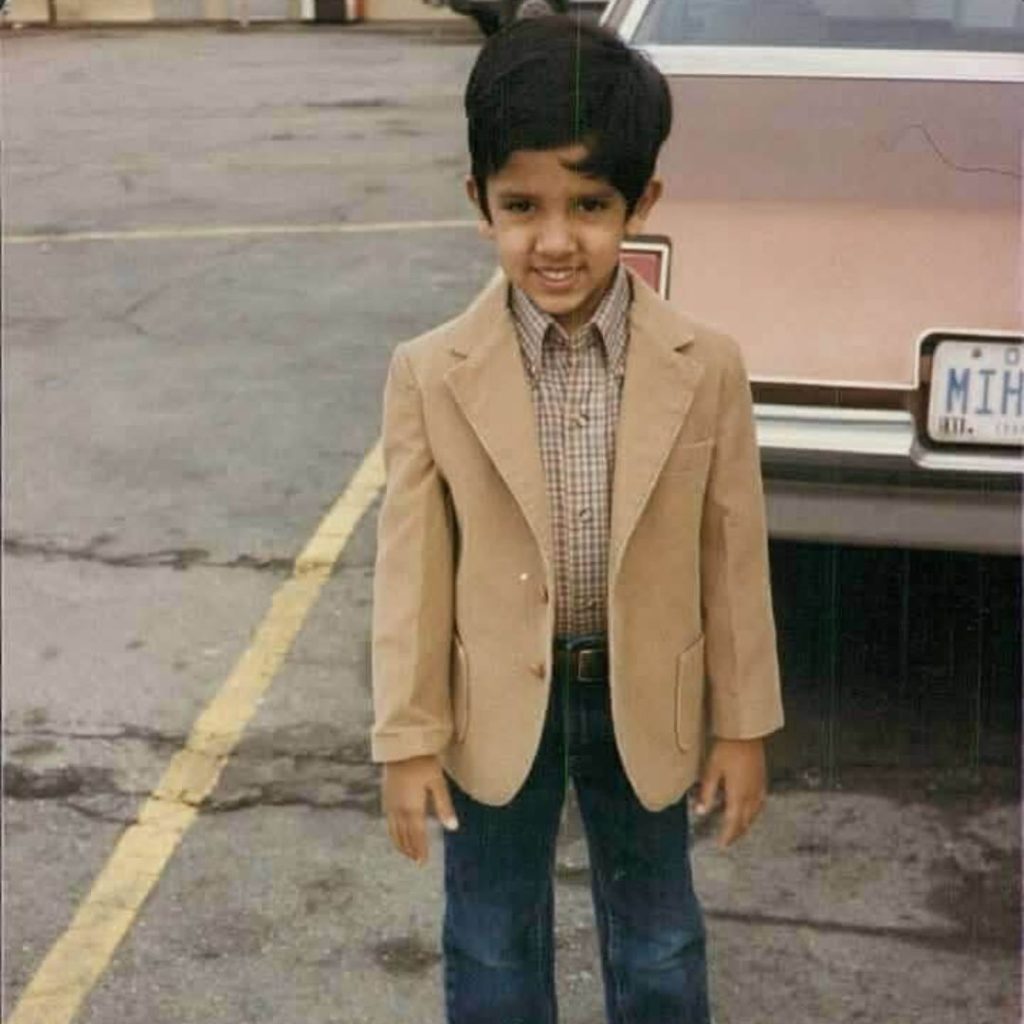
Dr. Summit Shah as a young boy. He grew up on Columbus’s west side, where his family lived at the 27-unit motel his dad owned.
What about someone who didn’t have family support? Do you still believe there’s no such thing as a self-made man?
Family is just one aspect, and it’s the one that’s nearest and dearest to me. But whether it’s family, the community around you, the education, or the country you’re born into, there’s always something. Thank God I was born in the United States of America. I think it’s the best country in the world. All those other factors could have been there, but if it’s not in the U.S., maybe the outcome isn’t the same. So yes, I still believe there’s no such thing as a self-made man. Maybe somebody doesn’t have family support, but there’s always something that bolsters and supports an individual in starting a company.

Dr. Shah with his family, who he credits for the foundation that made Premier Allergy & Asthma possible.
When you started Premier, what was your mindset? Did you set out to build 13 locations?
I have to rewind a little bit. I was working for a multispecialty clinic. I had signed a one-year contract, and it was my first real job at age 30 or 31. It took me that long to realize that when you work for a multispecialty practice, there are other allergists telling you how you have to treat a patient, how you have to do allergy testing, doing things that maybe I didn’t think were right for the patient.
So I came home on my lunch break three months into my first job and told my wife, “Hey, I quit my job this morning.” She was three months pregnant with our first child. Tears rolled down her cheeks, and she asked, “Well, what do you want to do?” I said, “I think I want to move back home to Columbus, Ohio, and start my own practice.” Of course, she was super supportive.
But I didn’t have a dream or vision. It evolved over time. I had learned from all these great gurus in Boston and in San Diego, where I did my residency and allergy fellowship, about new ways to treat allergies and new technologies. I just wanted to bring that back home and practice in the best way. There hadn’t been a new allergy practice in Columbus in probably over 50 years. There was great allergy care, but nothing novel. Coming back home and sharing what I’d learned with the community where I grew up was the impetus to start.
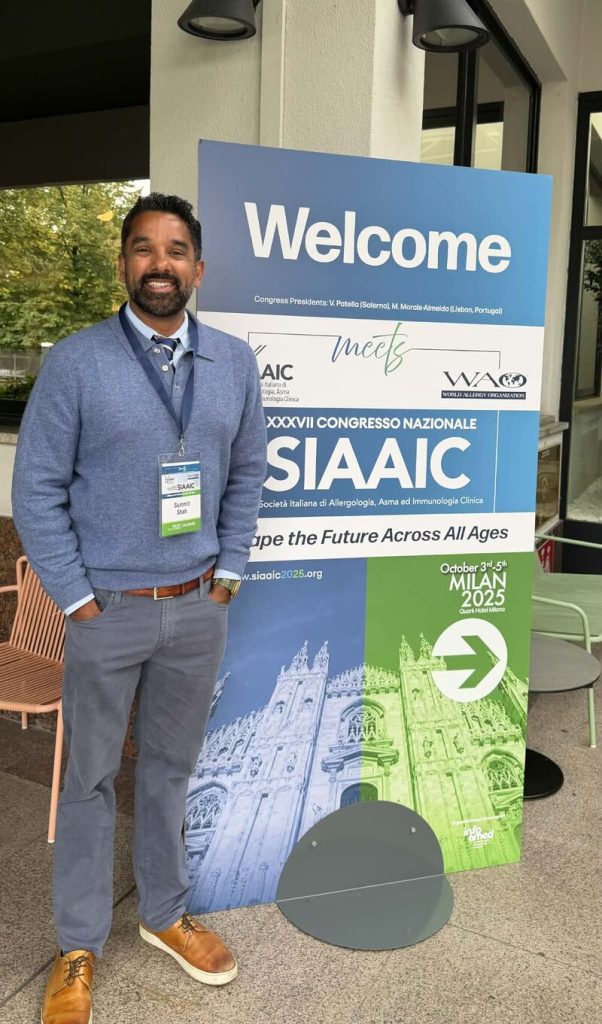
Dr. Shah at the 2025 SIAAIC national congress with the World Allergy Organization in Milan, Italy.
How did the practice grow from that first office?
It was really driven by patients, families, and referring doctors. Our first office was in Dublin, in the back of an OB-GYN office. Back in the day, when there were paper charts, you had to keep them for about seven years for liability purposes, and they were using that room to store their old charts. My realtor asked them, “Can you move these charts somewhere? We have this new doctor, Dr. Summit Shah, who’s looking for space.” It was literally a 700-square-foot office.
Then the families started coming to us. We started doing rush immunotherapy and oral immunotherapy, things we had been able to bring to Columbus that weren’t there before. The demand kept growing. Doctors in Westerville would call us and say, “We really need you guys out here.” Then Lancaster, Canal Winchester, Hilliard. It slowly grew because pediatricians and primary care doctors wanted us close to the families they served.
Was there a game-changing moment along the way?
I wouldn’t say a game-changing or aha moment. But every day when I wake up, I’m shocked and thankful for the employees who work at Premier Allergy & Asthma: how much ownership they take in their work and how hard they work. I never thought companies like that existed. It’s not an aha moment where we took off, but I’m very grateful for the team we have, because that is 100% the reason we’ve been so successful and been able to grow so much.

Dr. Shah with members of Premier Allergy & Asthma’s clinical team. He credits the team as “100% the reason” for the practice’s growth.
What was the hardest time for you as a business owner?
A few years into the practice, I was working full-time as an allergist and also trying to manage the business side: leases, contracts, insurance contracts, pharmacy licenses, all of it. We hit a rough patch where I couldn’t juggle both. I couldn’t work full time as an allergist and full time as an office manager, and I had two young kids at home. Things started falling through the cracks.
About three or four years into the practice, we needed a TDDD license from the Board of Pharmacy to expand from one location to multiple locations. I didn’t know that. We went through a whole legal mess, and it was very stressful. We had investigators; we had to get a legal team. It was rough, and pretty miserable while we were going through it.
But it was a good lesson not to overextend myself. Now we have people in place who are much smarter than I am at running the business, so we have a safety net to catch what can go wrong in any business.
What are your goals from here?
I have two girls in ninth and 10th grade, so we probably only have a few years left with them at home, although one of them says she might want to be a Buckeye like her mom and dad. For right now, I would love to concentrate on reaching families in Columbus and central Ohio.
You’d be surprised how many patients I meet who say, “My allergies are so bad, I just take a Claritin or an Allegra every spring and fall.” They don’t know that you can get tested and actually become unallergic through allergy immunotherapy. Or if you have food allergies, you can become desensitized and eat peanuts and drink milk. So my focus is getting the word out in the community I grew up in. If you have bad allergies or asthma, if you feel like you could perform better on the field, or if you don’t want to manage your food allergies by just carrying an EpiPen, there are other options, and an allergy practice can help.
Why is Columbus a great place to have a business and raise a family?
My wife, our kids, our close friends, and I like to travel a lot, so people always ask me, “What’s your favorite city in the world?” I always say Columbus, Ohio. People laugh at me, but I really believe it.
You hear this a lot, but it’s just such a livable city. People are so friendly here, especially in the entrepreneurial community, where everyone is such a connector. I’ve been part of EO, the Entrepreneurs’ Organization, a group of more than 100 local founders and owners from all different businesses. There’s an openness to helping each other and collaborating. “Hey, I’m looking for warehouse space.” “Has anybody dealt with this HR issue?” We’ve had so many pioneers and so many great businesses start in central Ohio. It’s a very entrepreneur-friendly city.
It’s safe. We have amazing schools. You can get through TSA at the airport in five minutes. The restaurant scene is picking up. I can’t say anything bad about it. And as an alum of Ohio State for undergrad and med school, the Buckeyes are here, so that’s the cherry on top.
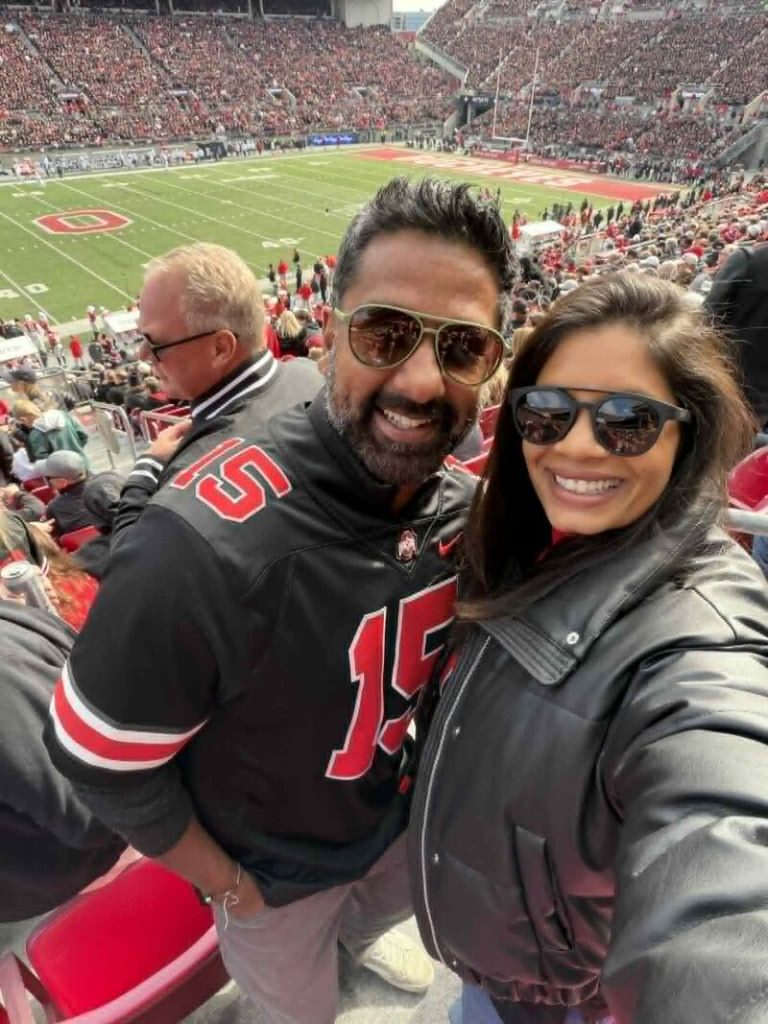
Dr. Shah and his wife cheering on the Buckeyes at Ohio Stadium. He earned both his undergraduate and medical degrees from Ohio State.
What’s your advice for someone thinking about starting a business?
If you’re considering it, take the risk. Take the leap. I was lucky to have a wife who was super supportive and family members who were very encouraging, whether it was going to medical school or starting a business. But for somebody young who’s on the fence, if you’re creative, if you have something unique you want to share with the community, or a different way of doing things, just do it. If it doesn’t work out, there are tons of other opportunities out there.
I kid you not, new allergists have opened up shop in Columbus and called me, and I give them the toolkit. “Do this, start this website, get credentialed with this company.” I’m all for it. If they have a unique product and they’re doing a good job, a high tide raises all ships. It makes all of us work harder and do better for our patients.
What’s the single best thing you’ve done for your business?
I’m not sure everybody would agree, but I invest time, energy, and resources in our employees, whether that’s continuing education or sending them to seminars for professional development. I probably know most of my employees by name. I know their spouses’ names, their kids’ names, and what activities they’re involved in.
Going back to what we talked about earlier, it comes from a place of gratitude. I’m so grateful for what they do and how much they care about the practice, so I try to show them that. Whether it’s having a tailgate or our annual company cruise, where we take all the employees and their spouses, it’s small ways to show them how important they are and how much I care.
Your family shaped the path you’re on. What do you do for your own kids?
We definitely focus on education. We send them to what I think is one of the best schools in Columbus, Columbus School for Girls. We also spend time volunteering with them and showing them different ways of life: how people can be economically different or come from different backgrounds, but we’re still a community, and we still have to take care of each other. We try to expose them to as much of that as we can.
A lot of parenting is what’s caught, not taught. Sometimes my wife and I sit down and try to lecture them about something, and it goes completely over their heads. More often, they see how their parents, aunts, uncles, and cousins act, and we hope they pick up those values and live them when they grow up.
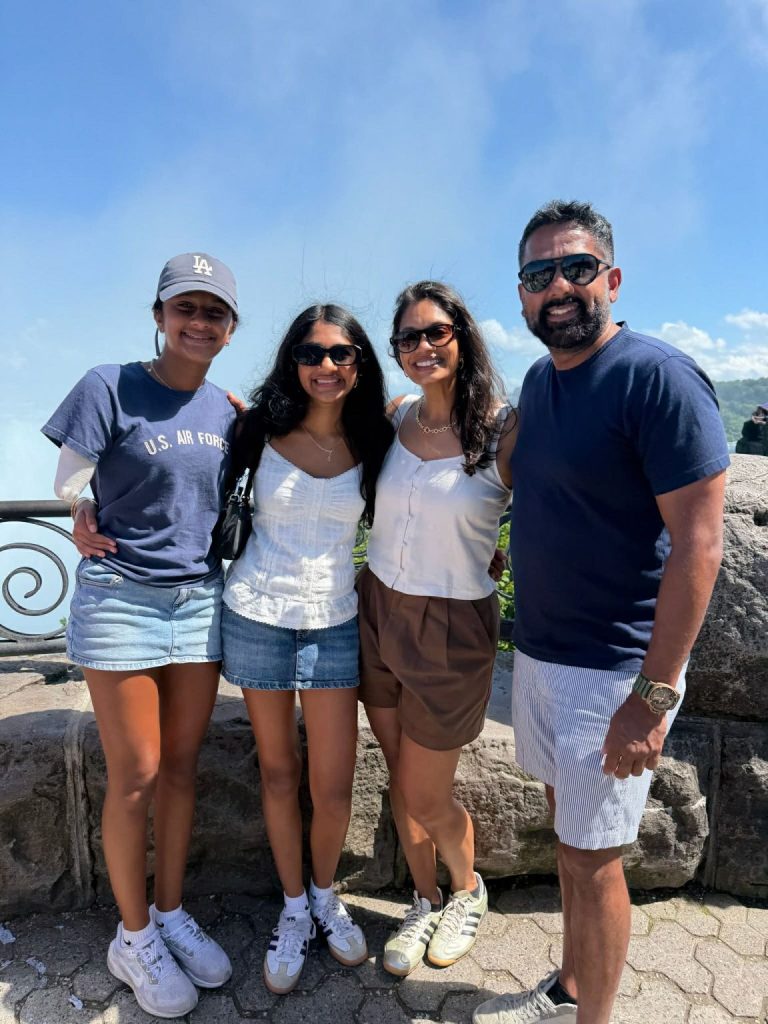
Dr. Shah with his wife and their two daughters.
Is there a patient who has stood out to you over the years?
Probably our first patient who underwent oral immunotherapy. He was an 11- or 12-year-old boy who had lived with a peanut allergy his whole life. He’d had multiple anaphylactic reactions, visits to the ER, epinephrine, and times when he almost couldn’t breathe. You could sense the anxiety in his parents when they brought him in.
With oral immunotherapy, we give patients incrementally small amounts of the food they’re allergic to. There’s a whole calculation behind it, but he would come in and get increasing amounts of peanut so that, over time, he could tolerate an accidental exposure. His mom was worried because he was starting to go off on his own: baseball games, traveling, overnight camp, middle school dances. Who knows, maybe in high school he kisses a girl at prom who’s eaten a peanut butter and jelly sandwich. Her stress was palpable.
He went through the process, and the relief we were able to bring that family, knowing he could participate fully and not worry about sitting at a certain table at school or missing overnight trips, made him probably the most impactful patient and family I can remember.
What’s a big risk you took that has paid off?
I don’t know if I’d call it a risk, but the climate for physicians has changed a lot. Fifteen or 20 years ago, most physicians were in private practice, individual companies, or running their own practices. Now many physicians are hospital-based.
One investment we’ve made that other medical practices maybe haven’t is in our infrastructure. We have a COO, a head of sales and marketing, a head of finance, and a head of operations who is an RN and oversees the nursing department. When I first started, I tried to do everything myself: be a doctor and run the business. Investing in that corporate structure gave us a foundation, and it’s one reason we’ve been able to grow. We have really smart people who know very little about medicine but know how to make an organization work and focus on culture, customer service, and the patient experience. That’s a risk that has worked out in our favor.
Many practices focus on volume. How did you develop your focus on patient relationships, and how has it served you?
I think it’s very closely related to practicing good medicine. If the patient doesn’t trust you, it doesn’t work. I just got a text from a patient I saw last week. I’d given her my cell phone number, and she said, “Doc, I’m still not feeling great.” So I got her set up with an appointment with me tomorrow. I still like to have that personal touch, because the relationship is so important, and then the medicine can come in. If you only do the medicine part, whether it’s allergy treatment or a prescription, without that relationship, it doesn’t bear as much fruit. That has served us really well, and we try to emulate it with all of our nurse practitioners and doctors, across the board, for every patient we see.